Showing posts with label field trips. Show all posts

Wednesday, September 10, 2008

Colonial Wiliamsburg

I feel slightly guilty for how little down time we've given my folks. They arrived from Johannesburg on Saturday night after tropical storm Hanna had left us and the very next day we started on our field trips.


The living museums at Colonial Williamsburg, Yorktown and Jamestown are holding their homeschool days for the next two weeks. We started off with a trip to Colonial Williamsburg on Sunday.

i wish I'd managed to arrange our schedules better, we only managed to spend 2/3's of a day in Colonial Williamsburg. This museum really needs a few days if you want to do it properly. I think that in March I might look into staying at a hotel with an indoor pool and spend 5 or 6 days leisurely visiting all the museums.

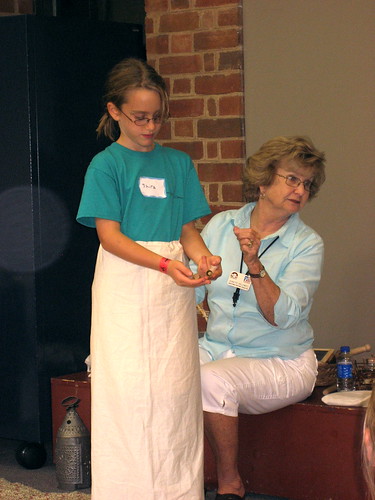
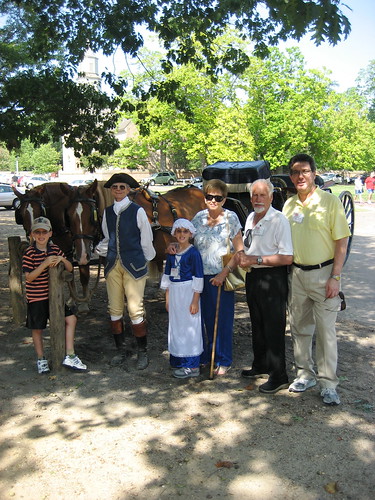
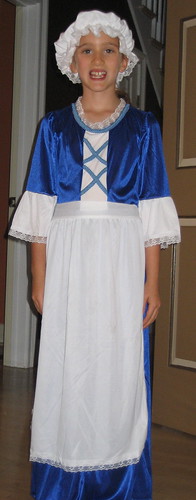
Shira dressed up as a little colonial girl. Got to love my kids. Shira makes up excuses to dress up in fancy costumes and Ben thinks that costumes are dreadful. If pushed, he'll put on his robe and tell you that he's a Jedi Knight or a biblical character (it depends on who the target audience is).


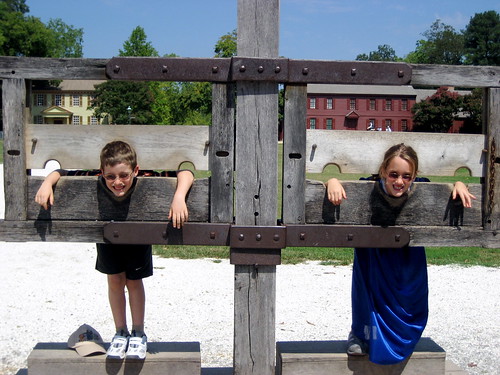
Don't you think this is the perfect method of disciplining children? I've told the children that when we return from vacation I am going to have a set built in our back yard.


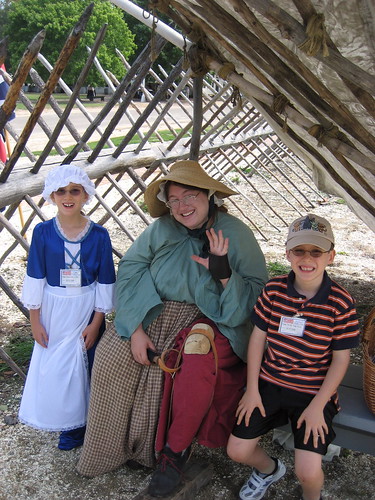
My favorite part of the entire trip was visit to the cobbler. The woman who manned the store was a gifted interpreter. She made a huge impression on the children. As soon as we left the cobbler we happened on this lady.


She is a cobbler's apprentice. She spent an age explaining exactly how the apprenticeship works. She even demonstrated all the tools she had made as part of her apprenticeship.

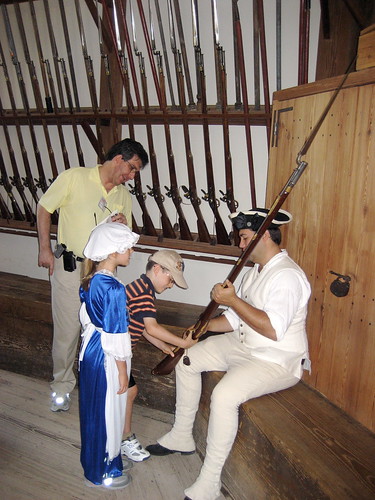
Unsurprisingly, the boys enjoyed the arsenal.


The highlight of our trip was the colonial chocolate we discovered. This chocolate is dairy and soy free and absolutely delicious. We were all in heaven.

Yorktown Victory Center

Yesterday we went to Yorktown Victory Center's Homeschool Day.

This was one of those field trips that was both wonderful and quite dreadful. I was rather bummed at how badly the tour guide we had massacred the material.

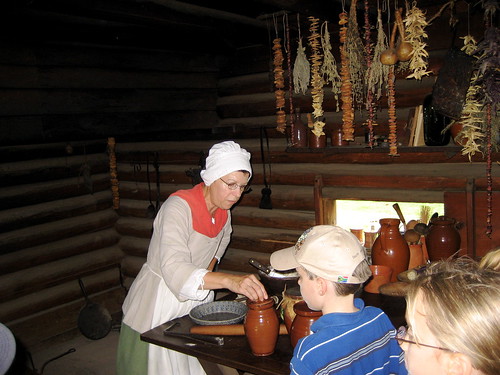
We started off with a two hour guided tour of the center. On the surface of it, it sounded like a great idea, however, having done it, I think it was a dreadful idea. The tour started at the model farm with the living interpreters. The parts of this portion of the tour where the living interpreters did the talking were outstanding. They knew how to pitch it at the children's level. We thoroughly enjoyed the woman who was cooking in the kitchen. The children now have a whole new appreciation of the lives of colonial women.


The tour fell apart though when the tour guide took over. He had no ability to talk to young children. Everything he said presupposed a good knowledge of revolutionary war and colonial history. I prepared my children well before we did the tour, but even so, the knowledge that he required was at an adult level.

If I were the organizer of this event, I'd have separated the groups by age groups and have had 2 much shorter tours for the young ones. Perhaps one of the farm and one of the military encampment. I'd also ensure that the guides are able to communicate with and enchant the children. Mine were not the only children in our tour who were bored to tears. Heck, the man even bored me and I was very interested in the topic.

However, it was not all a wash. The kids did get a huge amount of out the tour and loved getting close to this turkey.


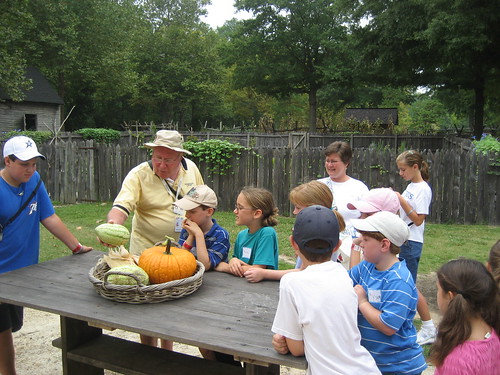
They also enjoyed looking at the fruit and vegetables that were grown on colonial farms. I was surprised at how small the watermelons were.


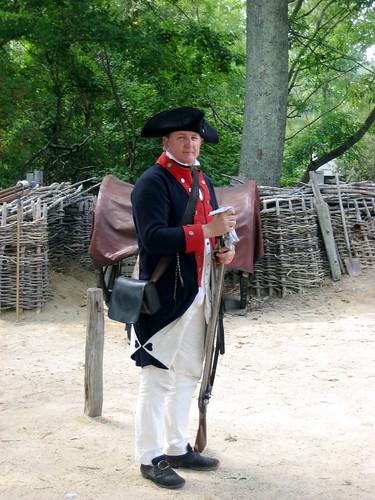
No surprises here, but Ben's favorite part was the military encampment. He was thrilled that this "soldier" demonstrated his weapon.


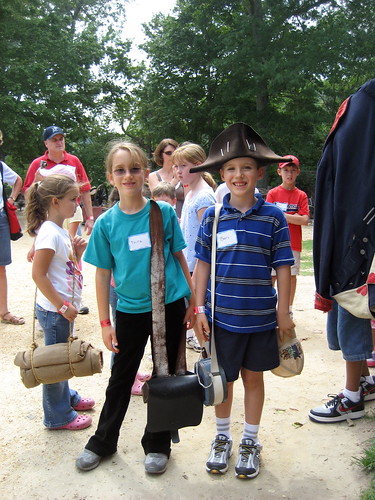
As usual, the dress up part was a huge hit.


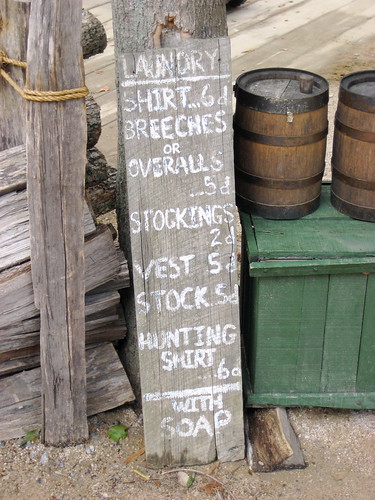
The kids were tickled by this sign. They thought it funny that they advertised that the laundry was done with soap.


After lunch we did a class on the tools people used during this time. It was very hands on and the teacher was exceptional in her ability to engage the children.

Shira got to put on pockets and an apron as if she lived in the colonial era.


They got to card wool, look at a gunpowder horn, play with colonial era toys and a host of other fun things.

All in all, I think this was worth while tour, however, I hope that the organizers make it more accessible to the younger set next time. Living museums are wonderful and can be made even more engaging when the adults who communicate with the children are passionate about transmitting their knowledge to said children.

Wednesday, August 27, 2008

Friday Field trips

Last Friday we went on two field trips. A tour of the WHRO studios and an ocean collection trip with the aquarium.

WHRO is our local public broadcaster. Despite our relatively small size, we are only one of 5 (I think) metropolitan areas that has 2 different public radio stations. I listen to the talk one and Marc listens to the classical music one.

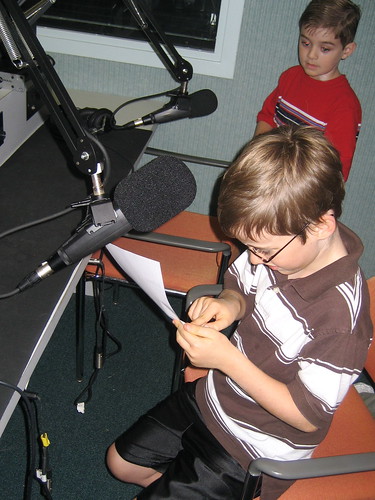
I'm not sure how much the kid learned, but nevertheless, they had a lot of fun. They particularly liked pretending to be radio announcers. The tour leader gave each child a script to read into the microphone. I just wish he'd switched on the mike and let the kids wear headphones.

It was a good experience for the kids to read out loud in public as this is a skill that is lacking in homeschools. My two want me to arrange for them to go to a preschool and read to the little kids. So far I've approached 4 preschools and they've all declined my offer. I am now thinking of seeing if the kids can get into the "Be a Reader" program in the elementary schools. I just am not sure if they will accept 7 year old children to work with other elementary schoolers.


The kids were also fascinated by the TV director's suite. Ben was taken by the split second timing that has to happen when broadcasting.

I highly recommend the Virginia Aquarium's Ocean Collection Tour.
Seahorses, stingrays, crabs and sand dollars - just some of what can be found beneath the surface of the ocean.

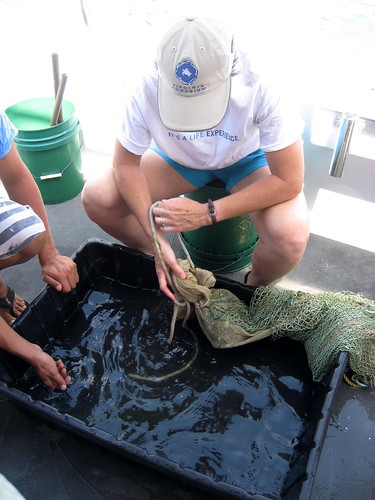
During this 75-minute boat trip, Aquarium staff will trawl the ocean floor for a sample of sea life to bring on board. Kids will have a chance to ask questions about the animals before they are returned to the water.
Cruises are offered March through November.


All three of us had a blast. The educators are great with kids and let them help out as if they were adults. Ben is still talking about helping to transfer the squids from the nets to the touch tanks.


As per usual, the highlight of the trip was totally out of left field. We found a huge, fiberglass shark on the dock. The kids spent way too long playing in it.

Wednesday, June 4, 2008

Homeschool Day at the Virginia Living Museum

I've rarely been as impressed by Homeschool Days as I was today by the one theVirginia LIving Museum put on for the Hampton Roads homeschooling community today.

Our day started off with a talk called, "Born to be Wild".

Here we learned about the Goliath Bird Eating Tarantula, the largest spider in the world.


We also learned about the American alligator. It turns out that I was a liar when I told the kids that there were no alligators in Merchant's Millpond when we went canoeing there a few weeks ago. There are apparently no alligators in Virginia, but a fairly sizeable population of large ones at Merchant's Millpond in North Carolina.

Thankfully the one we saw was a baby. The kids had a real kick out of touching it.


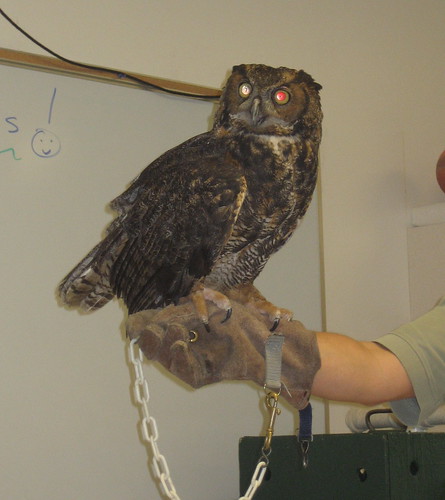
The kids were fascinated by the great horned owl. They were especially fascinated by the fact that they catch skunks and because they have no sense of smell, the skunk spray does not bother them. Apparently vultures are the only birds with a sense of smell. Ben spent a while trying to pretend he was an owl by trying to see around himself by turning his head, not his eyes. He discovered it wasn't a whole lot of fun.

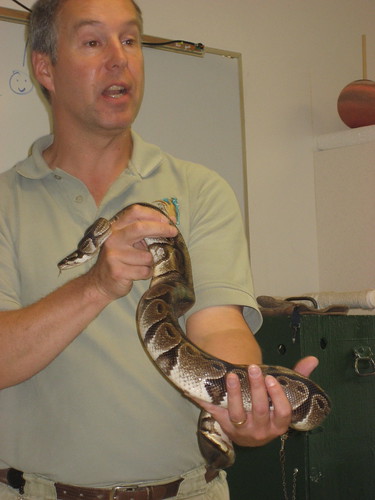
The ball python wasn't my cup of tea, but the kids loved it.

After this talk, it was on to the one on Animal ABC's.

Here the theme was not the alphabet, but how animals adapt to their surroundings.

The teacher was very clever when she showed the children the different types of bird beaks. She showed them a humming bird, a warbler and a cardinal. After she had described how well their beaks were adapted for the foods they eat, she pulled out a straw, a pair of tweezers and a pair of pliers and demonstrated their similarity to the birds' beaks.

This is something I always try to do with my kids and appreciate it when others do it as well. I've found that the more connections you draw for the kids, the better they remember and understand the subject matter.

After the birds, she showed us a box turtle, a land turtle. She showed the children how the box turtle's shell is more rounded than it's aquatic cousins, how it's shell is colored to give it great camouflage within the fallen forest leaves and how it has a hinge on it's under shell to allow it to withdraw into it when threatened.
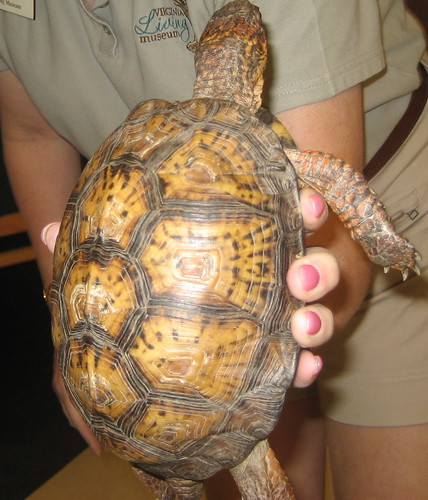
Did you know that you can tell a box turtle's sex by the color of it's eyes? Red or orange eyes mean it's a male while brown eyes signify a female.

I loved how she demonstrated and explained the duck's weatherproof coat. The kids enjoyed watching the water roll off the duck's back. The saying, "water off a duck's back", now has meaning for them. I never knew that the oil actually came from the feathers and that when the ducks ruffle their feathers, they are actually oiling them. I learned that this is called gleaning.


Did you know that a possum has four fingers and a thumb, just like humans, or that they have 50 teeth, more than any other land animal? Or that they are North America's only marsupial?


The final animal we saw in this talk was a Kestril, the smallest in the falcon family. I never realized that their eyesight was quite that good. They can see a mouse at a 100 yards.


The final talk of the day for Ben's and Shira's age group was "The Web of Life". This teacher was superb. She was funny and strict at the same time and kept the kids enthralled. The web of life is just up Shira's alley as she is turning into quite a little nature girl.
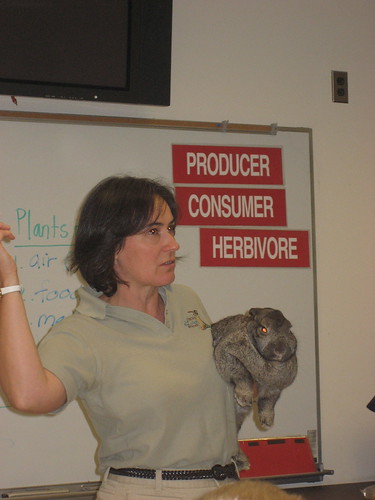

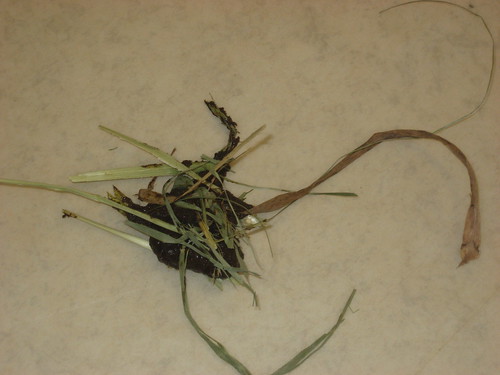
When she was showing this dear, little bunny, it decided to get back on me for banning the unpotty trained animals from my home by pooping at my feet.

The children also got to pet a "destinked" skunk.
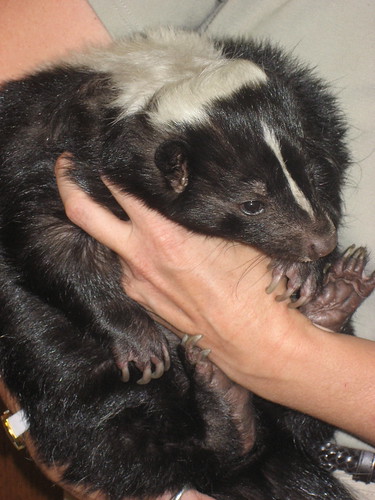

Ben and Shira tell me that the bunny's fur is much softer than the skunk's.

This teacher did a great job of explaining the food chain and the different types of "-vores". She ended with the decomposers and showed us some Betsy beetles.
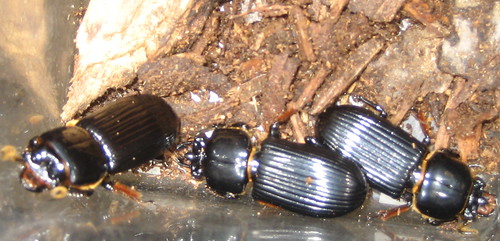

When we arrived home, after the visit, we did all the worksheets that the museum gave us to help solidify what the children had been taught. I'm not a big fan of worksheets, but these were well done and the kids enjoyed them.

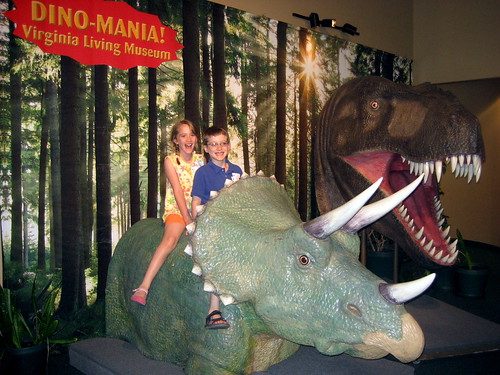
After the talks, we mooched around the museum. The kids loved the dino exhibit.

Here's Shira playing with the mechanical dino.

My budding paleontologist .


Having some fun.

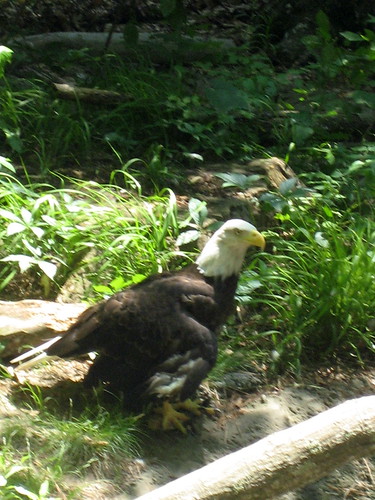
I think the highlight of the trip came during our walk of the trail where we saw two bald eagles.

We had a splendid day at the Virginia Living Museum and want to say a great big thank you to everyone who made this superb field trip possible. The kids can't wait for the next one.
Tuesday, June 3, 2008

The Heritage Center

We went on a great field trip yesterday. The Virginia Beach Farmer's Market has a Heritage Center where they teach children about farming and home life before the advent of modern creature comforts.

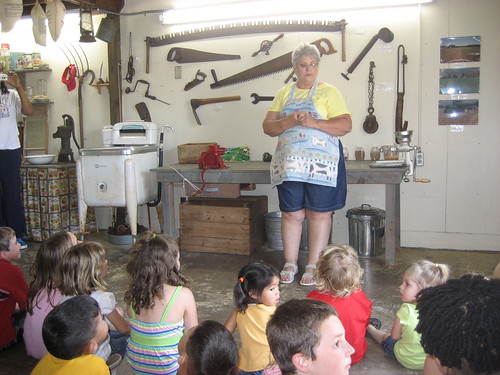
The kids were fascinated by all the non-electric tools.

The teacher did a great job of making the history accessible to the children.

I was a little disappointed though when she missed a golden opportunity to give a demonstration on gears and gear ratios when she demonstrated the butter churn.

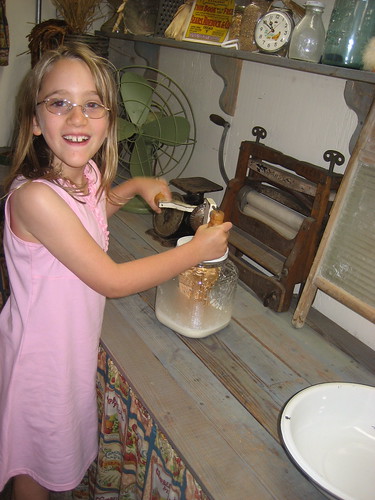
Here you can see Shira making butter.


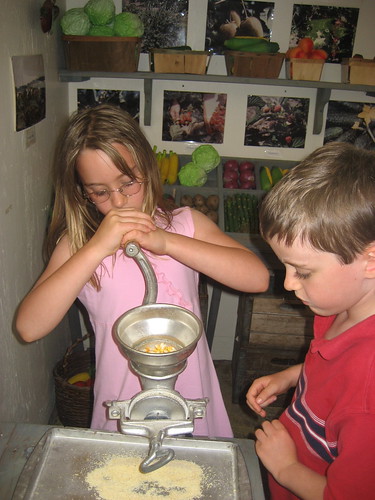
Ben and Shira learned that grinding corn is a tough business when you don't have a Vitamix.


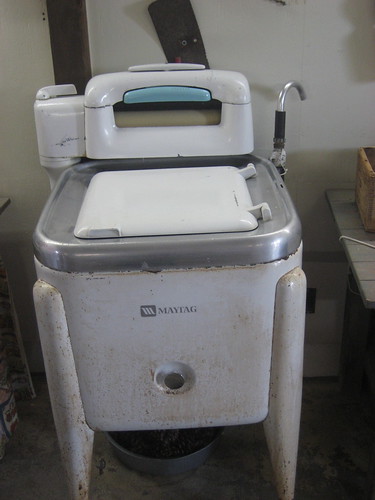
When I was growing up in South Africa it was a few decades behind the US. The backwardsness of the country was exacerbated by the fact that I grew up in a relatively poor, tiny town. Until close to the 1980's my family used a washing machine similar to this one.

I just loved using the mangle. I'll never forget the great excitement when one of my classmates bought an automatic washer and dryer in 1978. The entire school was agog over the machine that dried clothes. Now I can't imagine life without my automatic washer and dryer. How times change.

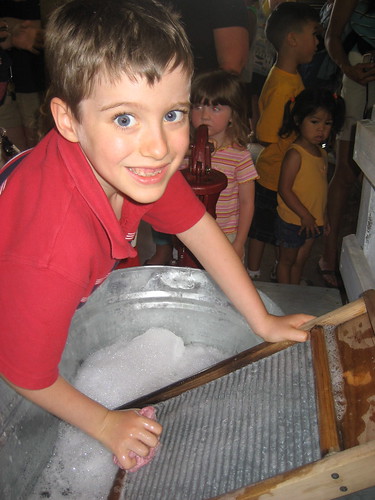
Ben had fun washing laundry on an old fashioned washboard.

I don't think it sunk in though just how much work washing laundry was in the days before washing machines.

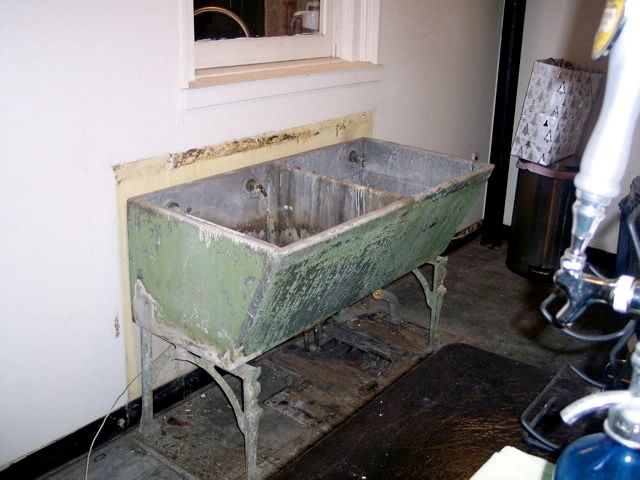
When I was growing up, our laundry had one of those old fashioned washing machines (ours was large and round) and two, large stone sinks with the corrugation of a washboard built into the angled front side. They were cleaned up versions of these ones.

Monday, May 26, 2008

Merchant's Millpond

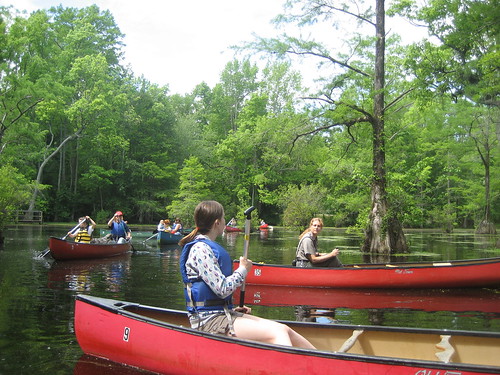
We spent a delightful friday morning canoeing on Merchant's Millpond in North Carolina. My girlfriend, Tina, lives a few miles from the pond. She arranged a trip for a bunch of us 3 years ago and we decided that now was the time to revisit the pond.

Ben was the primary motivator for the visit. When we went there 3 years ago he refused to ride in the canoe because he was afraid of falling out. I spent the entire time walking the trail with him while Shira went canoeing with my cousin, Janene, and the other homeschoolers. He figured that he would enjoy canoeing now as he has enough balance skills and has lost his fear of water

Last year Ben became proficient in the water and a few weeks ago he finally agreed to learn to ride his bike without training wheels. Now he can't understand why he was so scared of falling off his bike for so long. I almost wish he'd stayed scared because he is a holy terror on both his bike and scooter. Every day sees him trying a new trick. Yesterday he was scooting while pretending to be a cossack dancer. I've had to convince the kids that riding their bikes with no hands and eyes closed is a recipe for disaster, and is not a fancy trick.

Anyway, Ben no longer fears swings, bikes, canoes or anything that challenges his vestibular system, so it was off to Merchant's Millpond for a guided canoeing trip by Ranger Jane.

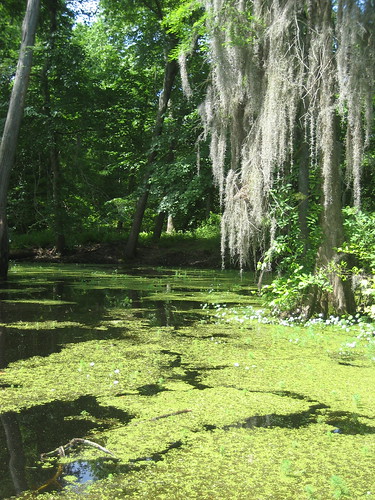
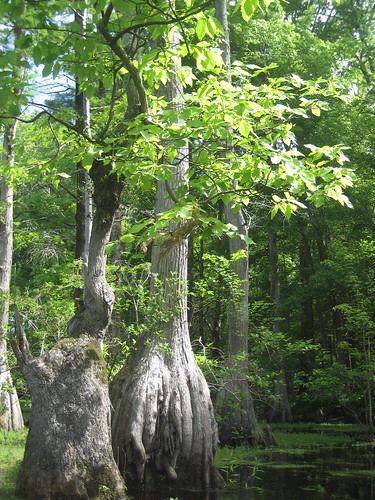
The 760-acre millpond is more than 190 years old and has developed into complex, mature ecosystems. Towering bald cypress and tupelo gum trees, displaying growths of Spanish moss and resurrection ferns, shade the pond's dark, acidic waters. Numerous species of aquatic plants, such as the floating yellow cow lily and the submerged coontail, thrive in the pond. A red and green layer of floating duckweeds and water fern often covers the water's surface. Moved about by wind and current, these floating mats create a changing mosaic of colors and patterns


Tupelo Gum
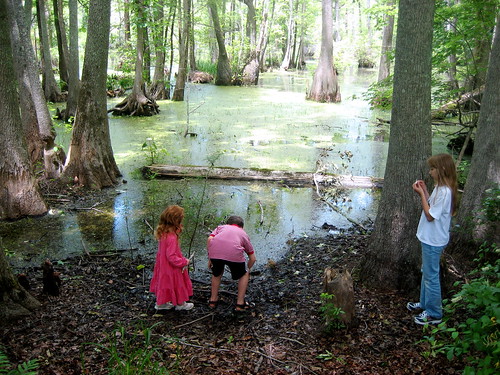
At the upper end of the millpond is Lassiter Swamp, an ecological wonderland containing remnants of an ancient bald cypress swamp — an eerie "enchanted forest" worthy of a fairy tale. Mistletoe has twisted and gnarled the trunks and branches of tupelo gum into fantastic shapes. Surrounding the aquatic communities is an unspoiled wilderness. Stands of American beech highlight a mixture of pine and hardwood forests.

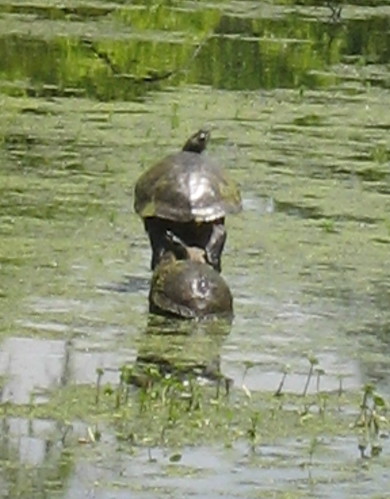
The diverse habitats in the park support a variety of animals. Wetland wildlife is particularly abundant. Frogs thrive in the aquatic environment of the millpond, and spring and summer rains bring a mixed chorus of carpenter frogs, leopard frogs, bull frogs, cricket frogs and species of tree frogs. Several species of pond turtles, often called cooters or sliders, bask on warm logs and stumps while the snapping turtle makes easy prey of other aquatic creatures. Water snakes are plentiful. Most of them are harmless, but the venomous cottonmouth is also present. Treat any encounter with a snake with caution and respect.


Cooters
In addition to game fish, two primitive species of fish — the long-nosed gar and the bowfin — inhabit the millpond. These interesting species have remained relatively unchanged for millions of years. Both the gar and the bowfin are large and important predators in the blackwater habitats of the coastal plain.

More than 200 species of birds, ranging from graceful egrets to turkeys and owls, have been recorded in the park. Spring and fall bring migrations of swamp warblers, parulas, prothonotaries and yellow-throated warblers. In winter, a variety of waterfowl stop by on their journey south. Lucky visitors may catch a glimpse of the beautiful hooded merganser, a small fish-eating duck whose males flaunt a magnificent black-bordered white crest. Pileated woodpeckers, barred owls, and red-shouldered hawks also enjoy the swamplands.

Paddling on the pond or creek is a great way to see several species of interesting mammals. Though beavers themselves are rarely encountered, dams, lodges, and teeth marks attest to their presence. Mink, river otter and bobcat are occasionally spotted. Deer, raccoons and opossums are also in residence. Bats roost in clumps of Spanish moss and are often visible at dusk when they dip to the surface of the pond to drink.

Our group getting ready to go out with Ranger Jane

I found that paddling with Ben was an interesting experience to say the least. Try as Shira and I might, we just couldn't get him to understand that paddling is a group effort and that he couldn't do things his way and not take head of what the other two people in the boat were doing. As luck would have it, Ben is hooked on canoeing and now wants to go kayaking closer to home. I need to find out if kids his age can go out in single kayaks. I'd love to go kayaking with the kids, but with each of us in our own kayaks.

After the guided trip was over, we had a picnic, then explored the park on our own.

Here are Ben and looking at interesting things

This was a great field trip and I highly recommend it to other area homeschoolers. We're planning on making this an annual event.