Showing posts with label science. Show all posts

Thursday, April 1, 2010

Bite-Size Physics

I am pleased to announce that my search for an upper elementary school/middle school physics program is over. The winner of this long and frustrating competition is Science Jim's program, Bite-Size Physics.


He's taken high school physics and made is accessible to elementary aged children. Some of the lessons contain math, but those are optional. Leaving the math lessons out does not detract from the program.

So why am I in love with this program?

Each lesson is written up in a friendly, easy to use format. I don't have to search through the net and the library for supporting information. What you see, is what you need. Each concept is backed up by easy to do, fool proof, experiments. You don't need specialized equipment.

As an example, in the first chapter, he explains what the scientific method is and then he has the children do experiments to practice the essential five steps of the scientific method. My kids think his mnemonic is hilarious - "Orange Hippos Take Classes Regularly". The first experiment is titled, "The Diabolical Diaper Dilemma". You need a disposable diaper, water, a large bowl or sink, a measuring cup and two people, to carry out this experiment. He carefully walks the students through the entire process.

His script has the children doubled over with laughter. I love that. Laughter and learning go well together. For me, the best part is that I can use the script without having to decipher it into plain English.

The second experiment is called, "Drops on a penny (A.K.A. Underwater Presidents). The goal of this experiment is to work out how many drops of water a penny can hold by using the scientific method.

After a third, fun and interesting experiment, he recaps the essential points and then there is a quiz.

Many of the experiments are supported by videos featuring Science Jim doing the experiment.

The program covers: The scientific method, mechanics, friction, energy, sound, atoms, static electricity and thermal energy.

I'll keep you updated but for right now, I am as happy as a clam. This is a plug and play program that is funny, academically rigorous, and very easy to use.

Sunday, March 15, 2009

Earthbox gardening

I am a green thumb challenged homeschooler who has been cursed, um blessed, with two children who are desperate to grow things. After it cost me in excess of $200 per tomato last year I swore off ever growing vegetables again.

In my defense, we have little or no room in our backyard and what room we do have is severely sun challenged. Last year I tried growing veggies in containers in the tiny area that does receive sunlight but they required so much watering (at least twice a day), that our water bill shot up by over $100 a month. I don't quite know what I did wrong, but I got weird vegetables that were eaten by wild creatures before we got to pick them.

Today I received a notification that Green Alternatives, a neat little ecostore around the corner from me, is hosting an Earthbox Meet Up on Saturday, 21 March at 2pm.


The little blurb got me excited that perhaps my plant killing days aren't yet over.
"An EarthBox is ideal for aspiring and experienced gardeners that are tight on space or just enjoy having a controled environment for their fruits, veggies, and herbs.
The class will be taught by a local professor who currently uses about 30 EarthBoxes for his gardening. "

I just had to google Earthboxes and discovered that these little boxes are on casters that allow you to move the boxes to the light. They also have the watering problems solved.
The EarthBox's plastic cover drastically reduces the water evaporation rate and returns condensed water vapor to the potting mix. As the plants draw water from the reservoir, they consume only what they need to stay healthy. Plants cannot be over-watered or under-watered if the reservoir is kept full. The plastic cover also prevents fertilizer from being diluted or washed away by rain.


The Tobagan government is using Earthboxes to solve their food security problems.

If a country can use Earthboxes to ensure they grow enough vegetables for their country, perhaps I can grow just part of the Silverberg family's vegetable needs.

Earthbox also has an entire education site. You can purchase the earthbox, together with education manuals for different grades.

I had a look a the sample on their website for the 2-5th graders and it looks like it might be worthwhile.

The website says
The curriculum support of the complete edition provides 17 standards-based sequential lesson plans divided into 45 minute classroom periods that require 60 days to complete in their entirety. Elementary Sample Lesson Plan.pdf. The 60 day time-line includes the treatment intervals between the real time experiments, but the actual lessons can be completed in twenty-seven, 45 minute periods. Not all lessons are interconnected. Instructors can choose the lessons appropriate to their objectives to focus on individual goals.

They also have pared down educational programs.

I'm really excited about the possibility that I too can have tomatoes like this


or spinach like this

Who knew spinach grew on vines?

This looks promising for someone like me. Perhaps I could have a real veggie garden this year and educate the children at the same time. Is anyone interested in joining me at Green Alternatives on Saturday 21 March at 2pm to find out about Earthboxes?

Tuesday, November 11, 2008

Is effective solar power around the corner?

IT Business reports that researchers from MIT have discovered a new way of storing energy from sunlight that could lead to unlimited solar power.
Sunlight has the greatest potential of any power source to solve the world's energy problems, Daniel Nocera, the Henry Dreyfus Professor of Energy at MIT and researcher on the project, said in a statement. In one hour, enough sunlight strikes the Earth to provide the entire planet's energy needs for one year.

The problem, however, is how best to harness that energy.

The research is a "giant leap" toward generating clean, carbon-free energy on a massive scale, said James Barber, a biochemistry professor at Imperial College London who was not involved in the solar project.

Nocera said he's hopeful that within 10 years people will no longer power their homes using electricity-by-wire from a central source. Instead, homeowners will be able to power their homes with solar power during daylight hours and use this new energy storage method for electricity at night.


Sunday, November 9, 2008

Project Feeder Watch

This info came through on a homeschool list I am on. We've signed up and are eagerly awaiting our materials.


You can download your handy, dandy, Homeschooler's Guide to Project FeederWatch -- a free science module for homeschoolers that focuses on Project FeederWatch! You can also learn about your backyard birds here.

The Cornell Lab of Ornithology has just released its newly revised, FREE Homeschooler’s Guide to Project FeederWatch.

For more than 20 years, Project FeederWatch has been an easy, fun way for children to learn about birds and strengthen their skills in observation, identification, research, computation, writing, creativity, and more. FeederWatchers keep track of the numbers and kinds of birds at their feeders through the winter and report what they see to the Cornell Lab of Ornithology.

The Homeschooler’s Guide to Project FeederWatch will guide you through bird-related activities that promote learning across many disciplines, including science, math, history, and the arts. Examples of these activities include:

Natural history: Observe and research a bird’s behavior and life cycle
Math: Calculate average seed consumption rate and graph data
Writing: Keep a nature journal to write stories and poetry
Geography: Research the geographic ranges of birds
Art: Keep a feeder-bird sketch book or create a papier mache mask To download the Homeschooler’s Guide to Project FeederWatch, visit www.FeederWatch.org and click on the “Education/Home School” button. You’ll be able to download the PDF in low (2.2MB) or high (6.7MB) resolutions.

You may choose to use the free guide as a stand-alone resource, or sign up for Project FeederWatch to submit the data you gather. If you would like to be a project participant, the signup fee is $12 for members of the Cornell Lab of Ornithology, $15 for non-members. There are discounts for group participation.

If you have any questions, please let us know how we can help by emailing feederwatch@cornell.edu.

Sincerely,
David Bonter
Project Leader, Cornell Lab of Ornithology

Sunday, June 22, 2008

Water Fueled Car Unveiled in Japan


This week we saw yet another case of media bias. The media apparently wants us to be all worked up and worried about gas prices because not a day went by this week that I did not see a dozen or more articles on the rising gas prices. However, I did not see more than one news article on this Japanese car that runs on water.

It runs on nothing but water poured into it's tank. One liter can last an hour at a speed of 80km.p.h (approx 50m.p.h.). This is exciting news yet the media is strangely silent.

Saturday, June 21, 2008

Ladybird Con!


I bought the kids a World Alive Ladybird Kit.

There was much excitement in our household because the back of the box promised, in detailed colored pictures, that we could order our ladybird larvae online, then watch them grow, pupate and emerge as beautiful ladybirds.

The problem arose when we opened the box and discovered a "Ladybug Kit Help Sheet for US Customers". Apparently in the US you can't buy the larvae, you can only purchase adult ladybugs.

I am so ticked off. This is false advertising. The kids were expecting to be able to watch the lifecycle of a ladybug, instead, they have a bug box and I have to pay an extra $7 for live ladybugs.

Friday, June 13, 2008

New 'super-paper' is stronger than cast iron

I find nanotechnology fascinating, partly because I'm a hard core science fiction fan and nanotechnology has featured in sci-fi for years.

Now the New Scientist reports that scientists have managed to turn cellulose molecules into a "nanopaper", 1/5000th the thickness of a human hair, that is stronger than cast iron and almost as strong as structural steel.
The secret to the nanopaper's performance is not only the strength of the undamaged cellulose fibres, but also they way they are arranged into networks. Although strongly bound together, they are still able to slip and slide over each other to dissipate strains and stresses.

Sunday, June 8, 2008

Sound

I was searching for ways to show Ben and Shira that sound is energy made by vibrations when I found this visual demonstration of sound waves.

Physics of Fluids - Waves in a large free sphere of water

This video is worth showing to the kids. Don Pettit of NASA on the 6th expedition to the International Space Station does various experiments with a free floating ball of water. I really like the one where he injects air into the ball of water and then injects small amounts of water into the air bubble.

Wednesday, May 7, 2008

eScience Labs

I hate it when I run across a concept that thrills me but for which my children are just too young. eScience Labs is just one such concept.

Far too often I hear homeschool moms of high schoolers lamenting their terror of teaching science and worst of all, teaching the labs. Far too many homeschooling parents have no knowledge about how to set up these labs and have a real dread about teaching them. eScience Labs appears to be the perfect product for all these terrified parents.

Just look at one of their high quality teaching videos


They even have a video that emphasizes safety in the lab, even if your lab is in the kitchen.

I really like their philosophy:
our primary mission is to expose students to the marvels of science, we don't want to exclude anyone.

For each topic presented we provide an online video introduction to help the student grasp and focus on the key concepts. Every lab is written with a carefully crafted, sequential introduction to lay the foundation for the experiments being performed. It is our intent that by the time they perform the lab, the student has the background and tools to ensure that it is a learning experience.


I know that these kits are for high school students, but I am seriously considering buying one to try with Ben and Shira. Ben, especially, is crazy about science and I wonder if some careful teaching won't make it possible that he'll thoroughly enjoy and learn from these kits.

As an educator, you are charged with providing effective learning experiences for your students. Your students are distance learners, however, and unlike in the traditional laboratory setting, your students' laboratory is their kitchen, their bedroom, or possibly their living room.

eScience Labs are far more than your typical "Hands On Kits". The broad academic and teaching backgrounds of our PhD level staff are focused solely on developing the best educational tools possible. We enable students to perform the same experiments they would find in a traditional "Brick and Mortar" academic setting; whether it is an AP high school class, community college or a 4 year college/university.

eScience Labs delivers:

  • Academically sound and thought provoking experiments

  • Flexibility

  • Real life examples

  • Supplementary online content

  • Online, email and telephone support


It is our philosophy that designing quality, well-structured labs takes a back seat only to safety. Some experiments require chemicals and other components that we feel are simply too dangerous for students to perform in an unsupervised environment. However, some of these experiments are important to understand. In these situations, we provide online video demonstrations that clearly and safely convey these concepts. The online content is also an engaging supplement to maximize the experience.


My geeky nature comes to the fore when I discover products like this. I'm almost wishing that Ben and Shira would hurry up their growing so that we could legitimately start using labs from eScience Labs. I love hands on science products that teach concepts hierarchically.

Friday, April 18, 2008

Mad Science

Last summer I met some folks at the Association of Virginia Homeschoolers conference who had the Richmond franchise for Mad Science.

I was enthralled by all the great science programs they offered children. Enthralled and jealous of Richmond homeschoolers. I wanted this resource on my doorstep, not in Richmond. A few weeks ago I was excited to discover that we have our own Mad Science franchise in Hampton Roads.

Fellow homeschoolers tell me that their homeschool science programs are superb. They are starting one on May 8th and I've signed Ben and Shira up for the class.

The blurb from their flyer states:
Mad Science of Hampton Roads is proud to announce that we will be offering
our popular Academy of Future Space Explorers course specifically for homeschooled students. Mad Science and the NASA Langley Center for Distance Learning collaborated to create this exciting program that sends children on a voyage of discovery. With unique hands-on activities, amazing demonstrations and fun educational take-homes, this is an experience that is truly
out of this world!


I haven't told Ben about this yet because I can't face daily interrogation about whether it is time to start the course on space yet. Ben's totally obsessed with space (and weather). He's going to be beyond excited to discover that he's going to be doing a 6 week course at Mad Science.

I was nosing around their website and found that they have done some research on children who have done their science courses.

A brief summary of the results are as follows: (more info can be found here.)

1. INCREASED SCIENCE CONTENT KNOWLEDGE
Students who participated in Mad Science showed significant change in their science content knowledge in space-related science on average, with an increase from 46% correct at pre-test to 65% correct post-test, a 19% increase in score. In contrast, comparison group students showed very little change in their science content knowledge with a slight increase
from 47% to 50% on average, a 3% gain in performance. The difference in pre to post-test gains between groups was found to be statistically significant.
2. INCREASED INTEREST IN SCIENCE
Students participating in Mad Science reported greater interest in space-related science after participation, with an increase from 21.6% who reported high interest in their pre-tests to 32.2% post-test. Comparison group students reported no change in their level of interest (22.3% pre and post).
3. INCREASED ATTITUDE THAT SCIENCE IS “FUN”
A significantly higher percentage of students who participated in Mad Science reported a change in their attitudes that “science is fun” after their experience (70% at pre-test to 83% post-test.) In contrast, comparison group students reported minimal change (67% at pre- test to 68% post-test).
4. INCREASED INTEREST IN SCIENCE IN LOW AND MODERATE INTEREST STUDENTS
39% of students with a low interest in science prior to exposure to Mad Science experienced an increase in their level of interest in science to either moderate or high after experiencing Mad Science. 29% of students with a moderate level of interest in science prior to exposure to Mad Science experienced an increase in their level of interest in science to high after experiencing Mad Science.


I'll report back after the kids have started their Mad Science class, so watch this space.

Friday, April 11, 2008

G.U.E.S.S. Homeschool Science Fair

What does a homeschool mother do when she wants her children to take part in a science fair? She, and a friend organize one.

On May the 5th this year, our children will take part in the first ever, Get Up and Explore Science Spectacular (G.U.E.S.S.) Homeschool Science Fair.

If you are reading this blog from the Tidewater area and want to sign up for the fair, click here . This is our "beta" year, so we're definitely working out the kinks, including online registration, generating sponsors, acquiring judges, and refining our guidelines. Next year we're planning to go even bigger, and hold the fair earlier in the year so that our winner can go on to the regional event in this area. If you'd like to be a part, please register by Monday, so we can finalize our list of entries. Updates coming soon!


We've had great excitement in our house over the experiments. Ben is fascinated by the weather and his first idea needed me to drive him to the beach 3 times a day for 21 days. I tried and tried, but couldn't convince him that there were better ideas, ideas that didn't need so much of my time and gas but he wouldn't have any of it. So, in typical mean mommy fashion, I got him up at o'dark 30 on the first day and took him off to the beach, then I told him that we'd have to do it well after bedtime and that for the next three weeks I was going to have to wake him up in the dark. That's all it took. Ben now has a different science fair project. Can't say I am disappointed. It's still weather related but only needs an anemometer and thermometer on our deck plus an internet connection. Works for me. He's getting a crash course in data collection and graphing. He's testing whether the actual temperature and wind chill in our very protected back yard are different from the actual temperature and wind chill at a nearby weather station that is not surrounded by brick buildings.

Shira is measuring how different solutions effect the longevity of cut flowers. So far, we can confirm that unlike humans, cut flowers do not thrive or even like wine.

I'm loving how working on the science fair is developing a love of science in my children. Lydia did a great job explaining concept of hypotheses to the children. One of our current favorite car trip activities is coming up with hypotheses that we could test. I see many more experiments in our future.

I used this as a great link in to the unit on Carl Sagan's "Baloney detection kit" that Dr Bernard Nebel talks about in his book, Building Foundations of Scientific Understanding: A Science Curriculum for K-2..

I knew that I had to teach Ben and Shira how to differentiate between reality and "baloney" but wasn't quite sure how to go about it within the scientific sphere. I've found that by following Dr Nebel's advice, that I it's quite easy. it just needs lots and lots of repetition and I don't doubt that I'll still be reminding the children of all the issues for many years.

I've spent years researching science curricula for the early elementary years and struggled to find anything that taught scientific concepts hierarchically and integrated them with one another. I was beyond excited when I discovered Dr Nebel's book. It's everything I could ever have wished for in a beginning science curriculum. I like how he makes it easy for the teacher to understand why she needs to do something and helps her build the connections for the children.

I especially like how he provides free online support.. You can't beat the price for this science program either, it costs $24.99 at Amazon.com and you can find most of the supplemental reading at the library. So far, I've managed to do all the experiments using stuff I have in my home.

I hope he finishes the 3rd-5th grade book before we finish this one.

Wednesday, April 9, 2008

Boogers, boogers and more boogers

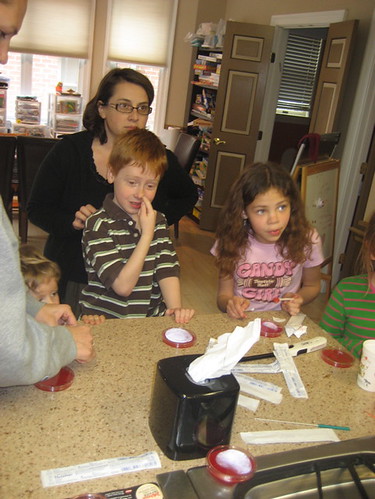
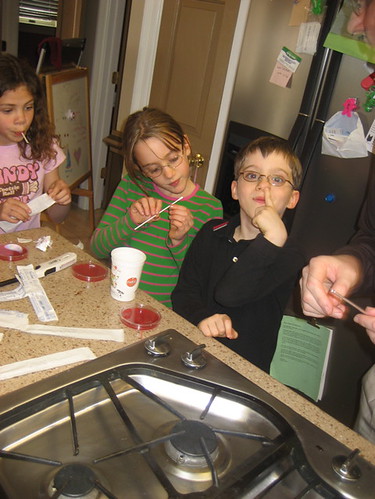
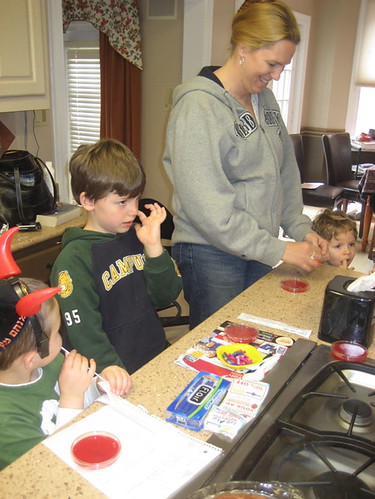
Marc started a great science project with the kids today. He is going to show the kids how much bacteria lives in their boogers and in their mouths.

Today he collected the samples and started culturing them. Next Wednesday after spelling bee, he plans on teaching the children how to make slides and then he'll pull out his microscope and show the children what grew out of their bodily excretions.

This experiment showed the differences between boys and girls yet again. The two girls swabbed the inside of their mouths, all the boys went mining for boogers.


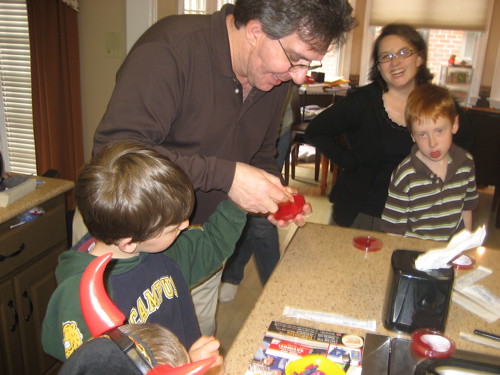
and here's Marc transfering booger to sheep's blood plate. He started off trying to do it the right way but it just wasn't working so he ditched the tools and switched to fingers.