Saturday, June 14, 2008

2,000-Year-Old Seed Sprouts, Sapling Is Thriving


Ha'aretz reports:
The wind ruffles the leaves of the date sapling in its planter, and Dr. Elaine Soloway quickly shields it. "There's only one plant like this in the world, and I'm still worried about it," she says. Methuselah - that is the sapling's name - is indeed unique. In 2005, Soloway, from Kibbutz Ketura in the Arava, germinated it from a 2,000-year-old date seed found at Masada.

For the past two millennia, since approximately the time of the Great Revolt of the Jews against the Romans, in 66-73 C.E., the seed lay dormant, until Soloway and her team breathed life into it, making it the oldest seed ever to germinate.

For two years, the seed was kept in isolation in a plant nursery to protect it from the modern diseases to which it would have been vulnerable. Now that it is stronger, Soloway is planning on transplanting it. "I think it has a future," she says.

Last week, Methuselah underwent chronological testing, using the radioactive isotope Carbon-14, which confirmed that the tree grew from a seed that lived when the Romans ruled the land.

If the sapling continues to flourish, Soloway believes they will be able to renew a species of date that grew in the Kingdom of Judea at that time. Soloway says the type of date grown by ancient Judeans disappeared in the centuries following the repression of the revolt.

Dates presently grown in Israel were brought here from other countries in the Middle East, particularly Iraq, and do not derive from ancient stock.

"People tell me the tree I'm raising looks like a typical palm you might see in your dentist's waiting room," says Soloway, who teaches at Ketura's Arava Institute for Environmental Studies. "But that's not true." Soloway says the first leaves that have sprouted are extraordinarily long. "We don't know yet if it's a male or a female, but if it's a female, in another two or three years we'll be able to know how dates tasted in Judea in ancient times."

According to historical sources, that taste was splendid. The Roman naturalist Pliny the Elder, who lived in the first century C.E., wrote that Judea's dates were known for their succulence and sweetness.

The date was identified so closely with Judea that Roman coins minted after the end of the Great Revolt depicted among its symbols a palm tree, together with the words "Judea Capta."

The seed from which Methuselah sprouted was found in a jar into which the inhabitants of Masada threw the pit of the dates they ate. Together with dozens of other seeds, it was found during excavations in the 1970s conducted by Professor Ehud Netzer.

The idea of germinating the seed came from Dr. Sarah Salon, of the Natural Medicine Research Unit of Hadassah Hospital, Ein Karem.

Soloway said that to resuscitate Methuselah, she soaked the pit in warm water and fertilizers. She then planted it "on Tu Bishvat, for luck." Soloway says she did not believe the seed still had life in it. But then, six weeks later, "the bed cracked, and two weeks after that, the first leaf came out. It was like a miracle, but the plant was still at risk. It had a strange color, a kind of marble-white. Apparently there was something wrong with the nutritional components in the seed, Soloway recalls. "In any case, when the seedling started to grow roots, after a few months, it didn't keep it from growing."

Soloway, 54, who comes from a California farming family, has been living at Ketura for more than 30 years. She deals mainly with medicinal plants at the Arava Institute, which trains people for environmental leadership roles. "To bring back the date palm of Judea to the world is not only a symbol, but is also useful to agriculture," she says. "But we are also trying to bring back other plants from the biblical period."

Soloway is also growing frankincense and myrrh, plants mentioned in the Bible, in her hothouse. She is now trying to acclimate the plants, which were brought from Somalia and Yemen. "Incense was made from these plants in the days of the Bible, but they apparently have characteristics that can make them very useful to modern medicine - especially as anti-inflammatories," Soloway says.


Scientists find bugs that eat waste and excrete petrol

The Times Online reports that Silicon Valley is experimenting with bacteria that have been genetically altered to produce "renewable petroleum".

What is most remarkable about what they are doing is that instead of trying to reengineer the global economy – as is required, for example, for the use of hydrogen fuel – they are trying to make a product that is interchangeable with oil. The company claims that this “Oil 2.0” will not only be renewable but also carbon negative – meaning that the carbon it emits will be less than that sucked from the atmosphere by the raw materials from which it is made.

Drop 'middle-class' academic subjects says schools adviser

This article in the Daily Mail made me feel like I now live in the twilight zone.

British professor, John White, believes that lessons should"
cover a series of personal skills.
Pupils would no longer study history, geography and science but learn skills such as energy- saving and civic responsibility through projects and themes.

Professor White wants ministers to encourage schools to shift away from single-subject teaching to "theme or project-based learning".

Pupils would still cover some content but would be encouraged to meet a series of personal aims. The curriculum already states some of these but is "hampered" by the continued primacy of subjects.

The aims include fostering a model pupil who "values personal relationships, is a responsible and caring citizen, is entrepreneurial, able to manage risk and committed to sustainable development".


Why bother sending your child to school at all if this is what they are going to be taught?

The dumbing down of the curriculum and grade inflation has lead to:
A leading university will become the first to introduce its own entrance exam for all applicants because A-levels no longer distinguish the brightest teenagers.

Imperial College will ask them to sit a problem-solving test as well as A-levels - claiming that grade inflation has left the gold standard exam "almost worthless".


This is yet another reason why I am glad we homeschool.

In our homeschool we concentrate on the basics, taught hierarchically which will ultimate lead (we hope), to children who will be able to logically analyze all information that comes their way.

Friday, June 13, 2008

New 'super-paper' is stronger than cast iron

I find nanotechnology fascinating, partly because I'm a hard core science fiction fan and nanotechnology has featured in sci-fi for years.

Now the New Scientist reports that scientists have managed to turn cellulose molecules into a "nanopaper", 1/5000th the thickness of a human hair, that is stronger than cast iron and almost as strong as structural steel.
The secret to the nanopaper's performance is not only the strength of the undamaged cellulose fibres, but also they way they are arranged into networks. Although strongly bound together, they are still able to slip and slide over each other to dissipate strains and stresses.

Sunday, June 8, 2008

The Chesapeake Bay and the Rivers emptying into it.

We have a huge problem here on the Chesapeake Bay. Pollution has destroyed the ecology of the bay

On Saturday, Ben and Shira attended the Save the Bay Day organized by the Elizabeth River Project where they helped pick up trash along the Elizabeth River.


It's amazing how good doing mitzvot (good deeds) makes the children feel. I've built a strong anti-litter ethic in my kids and they often ask if they can don gloves and walk around the neighborhood picking up trash. They consider it being a good neighbor.

The first time they were introduced to this concept was when they were around three and we came across a neighbor's car that had been broken into. There was glass all over the road. This neighbor is elderly, so we swept up the glass for him. I find it fascinating how this simple act has stayed with the kids for all these years.

My anti-litter campaign has had interesting results. I forgot that 7 year olds see the world in black and white. The kids have now become passionate anti-litter campaigners and speak out loudly when they see littering happening.

Anyway, back to the Elizabeth River and the Chesapeake Bay. Here is what the Elizabeth River Project" has to say about the River.
To accommodate modern lives, not just in Portsmouth but also Norfolk, Chesapeake and Virginia Beach, the Elizabeth River started to be filled to two-thirds her normal width and dredged to twice her normal depth. Now what do you suppose has happened to the wetlands and shallows that once supported the abundant crabs and fish? Yes, our Elizabeth River has lost 50 percent of her tidal wetlands and her shores have been converted to concrete as much as six miles at a stretch. Wetlands are amazing ecosystems that help filter nitrogen, control erosion, serve as habitat and are as precious as coral reefs.

Into the 1900s, the harvest of oysters was banned due to contamination from sewage and is still banned today. And down the Southern Branch there is a site known as Money Point where wood treatment facilities coated the great timbers with tar, made into “creosote” and let it drip and wash into the river bottom. Now what’s the problem with that? Scientists say the creosote pooled on the bottom of the Elizabeth’s Southern Branch and represents some of the highest concentrations in the world --- and that’s associated with cancer in our fish and risks to human health.

Now for a bit of hope, early as 1940 your communities realized they wanted a healthy river, not just a great harbor. Hampton Roads Sanitation District began the job of managing your sewage. In 1991 four citizens founded the Elizabeth River Project around a kitchen table based on the belief that citizens, government and industry can work together, hand in hand, to achieve the balance of a healthy river and a healthy economy. Out of such an unusual idea was born a most powerful partnership. Today we see the powerful results on every shore, brought about by dozens of industries, government partners and ordinary citizens, rallying for your river’s restoration! The industrial stewards are called River Stars!

In 1999 the Norfolk Naval Station, the world’s largest naval base located at the mouth of our Elizabeth was named the first Model Level River Star with the Elizabeth River Project for voluntary progress reducing pollution and restoring vital habitat. Today we have 60 River Star industries participating, including almost every one of the largest industrial interests on the river, and this year alone they documented reducing pollution by 3.4 million pounds! Not only are today’s port facilities reducing pollution. They’re bringing back the green shore. In fact in 2004, one of our River Stars, Norfolk Naval Shipyard, actually won an award from the White House for restoring a wetland. The Naval shipyard wetlands are part of a project that the national head of the US Environmental Protection Agency has called a model for the nation!

And as for that nasty creosote creating fish cancer on the Southern Branch - the Elizabeth River Project is helping coordinate not one but three cleanup projects with public and private partners. Soon the goo will be gone from Elizabeth’s bottom! And what about the oysters that once each made a meal for early residents. Partners have restored more oyster reefs on the Elizabeth than anywhere on the Chesapeake Bay! One can look along the shore and you’ll see them growing today on every piling. In fact, by the year 2000, the Elizabeth River showed the MOST IMPROVING TRENDS for water quality on the entire Chesapeake Bay! But she still has a long way to go and each of us has a chance to be part of this legend.


The Elizabeth River Project is not the only organization working on rehabilitating the Bay.

Bob Vorth of the Virginia Institute of Marine Science (VIMS) has spearheaded a project that has planted 1,400 continuous acres of eel grass, the largest sea grass restoration in the world, in the Chesapeake Bay at the Eastern Shore. His objective this week is to capture about 20 million seeds from existing plants, cure them in a new facility just opened in the town of Oyster, and spread them around this fall in the coastal bays, as well as in the York and James rivers off the Chesapeake.

This is vital to the rehabilitation of the bay. As without grasses, the Bay lacks habitat for crabs and shellfish and does not breathe life-sustaining oxygen into the water as before.

You can read the entire article here.

Sound

I was searching for ways to show Ben and Shira that sound is energy made by vibrations when I found this visual demonstration of sound waves.

Physics of Fluids - Waves in a large free sphere of water

This video is worth showing to the kids. Don Pettit of NASA on the 6th expedition to the International Space Station does various experiments with a free floating ball of water. I really like the one where he injects air into the ball of water and then injects small amounts of water into the air bubble.

Saturday, June 7, 2008

A battle between a pride of lions, a herd of buffalo, and 2 crocodiles

I found this video on YouTube, did some research and discovered more info on Maniac World


This is the Battle at Kruger. This is an amazing battle between a pride of lions and a heard of buffalo. When the lions capture the baby buffalo, they think the battle is over - but really it's just begun. An army of buffaloes come back in a mobilized front to take the baby back. For good measure, a couple of crocodiles join the foray, but don't make much of an impact.

The Facts:

Battle at Kruger is a viral video which was widely praised for its dramatic depiction of life on the African savannah.

It was also the subject of an article in the June 25, 2007 issue of Time Magazine and was featured in the first episode of ABC News' i-Caught, aired on August 7, 2007. A National Geographic documentary is also planned. Filmed in September 2004 by videographer David Budzinski and photographer Jason Schlosberg at a watering hole in Kruger National Park, South Africa, the video depicts a confrontation between a herd of Cape Buffalo, a small pride of lions, and a pair of crocodiles.

Taken from a vehicle on the opposite side of the watering hole, the video begins with the herd of buffalo approaching the water, unaware of the lions resting nearby. The lions charge and disperse the herd, picking off a young buffalo and knocking it into the water. While trying to drag the buffalo out of the water, it is grabbed by a pair of crocodiles, who fight strenuously for it before giving up and leaving it to the lions. The lions sit down and prepare to eat, but are quickly surrounded by the reorganized buffalo, who move in and start kicking at the lions. After a battle which includes one lion being tossed through the air, the baby buffalo (who is miraculously still alive) escapes into the herd. The emboldened buffalo chase the remainder of the lions away. It is not known if the youngster survived the ordeal.

Two veterinarians and animal behaviorists interviewed by Time assert that the behavior exhibited by the buffalo is not unusual. Dr. Sue McDonnell of the University of Pennsylvania (School of Veterinary Medicine) said of the video:

"The larger herd is broken down into smaller harems, with a dominant male and several females and their babies. If a youngster is threatened, both the harem males and bachelor males - which usually fight with one another - will get together to try to rescue it."

Amongst the very few things that I miss about South Africa, is the bush. I used to wait until a Thursday then call all the private lodges to see what specials they had. They generally offered steep discounts on unsold stock. This way I got to spend glorious weekends at private lodges I would not normally be able to afford. Lodges like Thornybush Private Game Reserve, Ngala, Inyati, Singita, Sabi Sabi, Ulusaba and Mala Mala.

Nothing beats a early morning game drive or walk. One time at Ulusaba we walked through a herd of zebra and came within a dozen feet of a giraffe. Another time, I was driving through Mala Mala to the camp when a rhino trotted alongside the car for ages.

I look forward to taking Ben and Shira to the bush once they are older. If we lived in South Africa, I would have taken them to the lodges already but that 19 hour flight from NYC to Johannesburg does not do good things to young children, that and the 7 hour time change.

Here's another buffalo vs lion movie
7 members of the Nduna pride downed a buffalo calf. It's cries bring back the herd. The lions try to hang on to their prize but are chased off by the buffalo several times. The calf's mother comes to its assistance and amazingly after being under lion tooth and claw for 10 minutes the calf gets up and follows its mother.


Just a note to end. My accent is nothing like those you hear on the videos, just in case you thought all South Africans sound that flat.

Are you an overachieving homeschooler?

I found this quiz on Deborah Marcus' Secular Homeschooling

My score was 33 which apparently means that I am:

Getting there. You generate a respectable amount of resentment, but the animosity you and your brilliant brood inspire is purely localized.


The quiz is extremely funny, do it just for the fun of the questions.

However, this brings me to a topic near and dear to my heart, the concept of the overachiever.

I wish I knew why people who do well are considered overachievers. I've been accused of being one my entire life, as has my husband. So called, "overachievers", are by and large people who do their best at everything they do. The average person apparently can't stand this so they came up with a slur to try to make it sound as if people who achieve are somehow psychologically unsound. it drives me crazy, totally and utterly crazy.

There is nothing wrong with mediocrity, but please, accept that you want to be mediocre and enjoy it. Let those of us who like to do everything to the best of our abilities also just enjoy it. We don't create slurs for the mediocre or underachievers, so please let us be.

Traveling Families

I'm sitting in the lobby of the Downtown Marriott in Richmond, watching homeschooling families check out. It's been a real education for me as I never get to see traveling families. We always travel while school's in so that we avoid crowds.

I no longer feel like a freak. Almost all the families are laden with cooler boxes, kids blankets, pillows and stuffed toys. It really feels good sometimes to know that you aren't the only mom who feels like the household goods move with her when she travels. I always have huge cooler boxes filled to the brim with food (we all have food allergies so the only way to ensure that my family eats safely, is to bring our food with us). Ben, Shira and I, all need our own pillows and blankies, plus the kids need their special stuffed toys.

Talking about traveling with food brings me to my exciting news. I am getting a week off cooking in July. Do you have any idea how big this is? With our food allergies, I never, ever get a break from cooking, not even when we vacation. Even if we find safe restaurant food, the kids balk at it after a few meals. I can't say I blame them as restaurant food is too salty, too sugary and too oily for us.

We're going to Dr Fuhrman's retreat in the Poconos. I initially ignored all the advertising as I expected it to be filled with guru worshipers. Then I discovered that all meals were included and we'd have a large choice of safe food for every meal and more importantly, we cook the same way as Dr F. No processed foods, no salt, no oil and lots and lots of whole foods.

There is even a kids' camp, so if I want time to myself, I can put the kids into the kids' adventure camp.

I can't wait. This is going to be a true holiday for me. I won't have to do a scrap of work and the food is going to be fantastic.

Thursday, June 5, 2008

Off to the HEAV conference

I'm off to Richmond for three days for the HEAV conference. I always suffer from great angst before I go to these conference as I am a hard core secular homeschooler and this is a Christian conference. I feel overwhelmed by the Christian greetings that abound, and always have to remind myself that I am the visitor and should respect the attendees beliefs.

However, the sheer number of lectures on offer makes this very attractive. Even when you factor out the lectures like, "Obedience from the Heart", "Teaching students to defend Christianity" or ""Building World-Changing Leaders for Christ", there is still an almost over abundance of lectures from which to choose. My problem is always narrowing down my choices.

Right now I am thinking of attending the following lectures:

  • More than a game: Chess and its impact on learning

  • Evaluating student writing: You don't have to be an English Major, OR, Introducing Analytical Grammar

  • Gateway to the Classics: The right literature at the right time, OR, Asking the right questions - Teaching literature with Socratic Discussion

  • Homeschooling your gifted child.

  • It's Much More than Maps from Geography matters. OR, The biology of behavior I. OR, Lapbooks across the curriculum, OR, Reaching the Reluctant writer.

  • The biology of behavior 2, OR, The 4 C's of Lego Learning


Tough, tough decisions. I have wanted to meet Dianne Craft for ages as I think her information on the biology of learning can really help my kids, however, the Lego learning is something I dearly want to do. I can see how I am going to have to attend one lecture and buy the CD of the other.

Probably the best part of the entire conference is the curriculum fair (both new and used). While I am a big user of the net to buy curricula, I have a few products that I really want to be able to look at in detail to help me make decisions.

i'll blog about the lectures I choose.

Wednesday, June 4, 2008

Homeschool Day at the Virginia Living Museum

I've rarely been as impressed by Homeschool Days as I was today by the one theVirginia LIving Museum put on for the Hampton Roads homeschooling community today.

Our day started off with a talk called, "Born to be Wild".

Here we learned about the Goliath Bird Eating Tarantula, the largest spider in the world.


We also learned about the American alligator. It turns out that I was a liar when I told the kids that there were no alligators in Merchant's Millpond when we went canoeing there a few weeks ago. There are apparently no alligators in Virginia, but a fairly sizeable population of large ones at Merchant's Millpond in North Carolina.

Thankfully the one we saw was a baby. The kids had a real kick out of touching it.


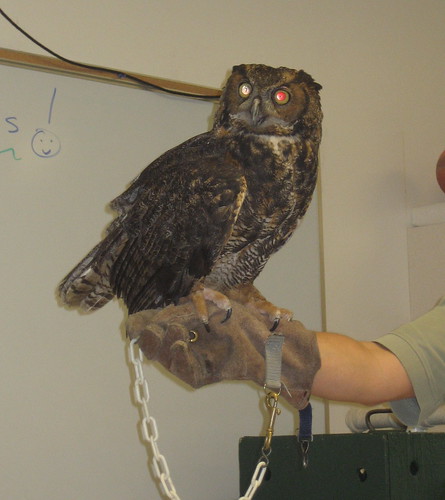
The kids were fascinated by the great horned owl. They were especially fascinated by the fact that they catch skunks and because they have no sense of smell, the skunk spray does not bother them. Apparently vultures are the only birds with a sense of smell. Ben spent a while trying to pretend he was an owl by trying to see around himself by turning his head, not his eyes. He discovered it wasn't a whole lot of fun.


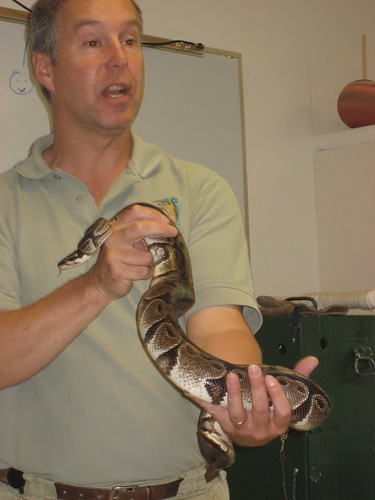
The ball python wasn't my cup of tea, but the kids loved it.


After this talk, it was on to the one on Animal ABC's.

Here the theme was not the alphabet, but how animals adapt to their surroundings.

The teacher was very clever when she showed the children the different types of bird beaks. She showed them a humming bird, a warbler and a cardinal. After she had described how well their beaks were adapted for the foods they eat, she pulled out a straw, a pair of tweezers and a pair of pliers and demonstrated their similarity to the birds' beaks.

This is something I always try to do with my kids and appreciate it when others do it as well. I've found that the more connections you draw for the kids, the better they remember and understand the subject matter.

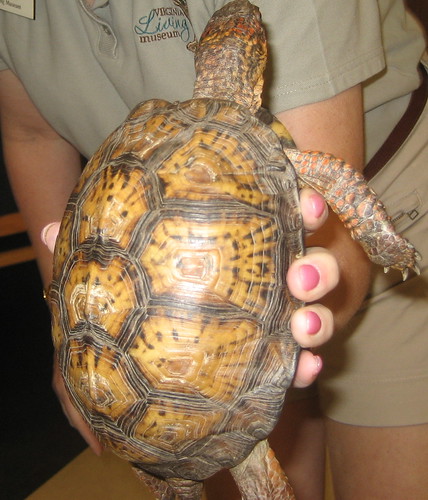
After the birds, she showed us a box turtle, a land turtle. She showed the children how the box turtle's shell is more rounded than it's aquatic cousins, how it's shell is colored to give it great camouflage within the fallen forest leaves and how it has a hinge on it's under shell to allow it to withdraw into it when threatened.

Did you know that you can tell a box turtle's sex by the color of it's eyes? Red or orange eyes mean it's a male while brown eyes signify a female.

I loved how she demonstrated and explained the duck's weatherproof coat. The kids enjoyed watching the water roll off the duck's back. The saying, "water off a duck's back", now has meaning for them. I never knew that the oil actually came from the feathers and that when the ducks ruffle their feathers, they are actually oiling them. I learned that this is called gleaning.


Did you know that a possum has four fingers and a thumb, just like humans, or that they have 50 teeth, more than any other land animal? Or that they are North America's only marsupial?


The final animal we saw in this talk was a Kestril, the smallest in the falcon family. I never realized that their eyesight was quite that good. They can see a mouse at a 100 yards.


The final talk of the day for Ben's and Shira's age group was "The Web of Life". This teacher was superb. She was funny and strict at the same time and kept the kids enthralled. The web of life is just up Shira's alley as she is turning into quite a little nature girl.


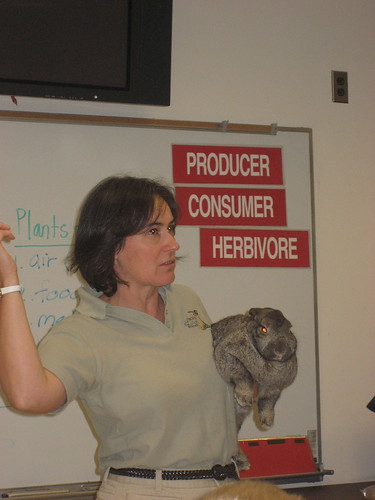
When she was showing this dear, little bunny, it decided to get back on me for banning the unpotty trained animals from my home by pooping at my feet.


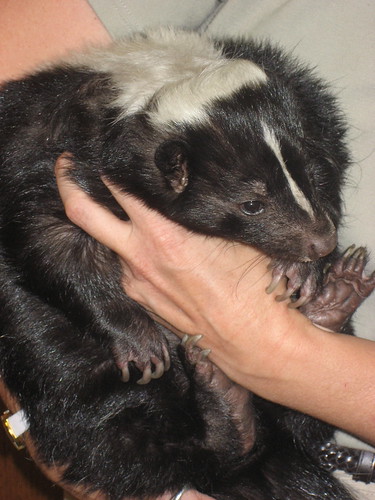
The children also got to pet a "destinked" skunk.


Ben and Shira tell me that the bunny's fur is much softer than the skunk's.

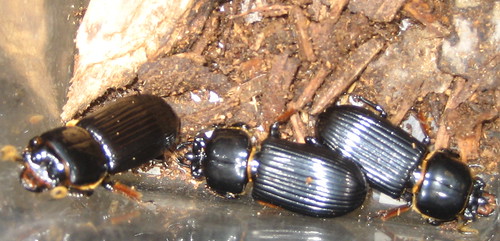
This teacher did a great job of explaining the food chain and the different types of "-vores". She ended with the decomposers and showed us some Betsy beetles.


When we arrived home, after the visit, we did all the worksheets that the museum gave us to help solidify what the children had been taught. I'm not a big fan of worksheets, but these were well done and the kids enjoyed them.

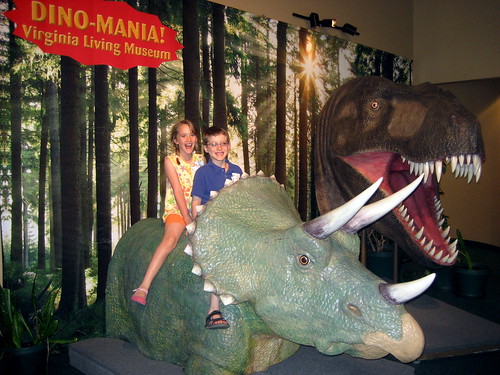
After the talks, we mooched around the museum. The kids loved the dino exhibit.

Here's Shira playing with the mechanical dino.

My budding paleontologist .


Having some fun.


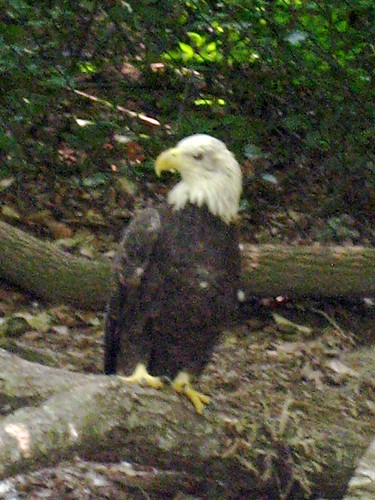
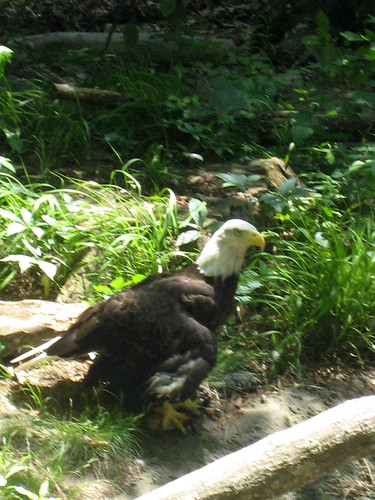
I think the highlight of the trip came during our walk of the trail where we saw two bald eagles.


We had a splendid day at the Virginia Living Museum and want to say a great big thank you to everyone who made this superb field trip possible. The kids can't wait for the next one.

Tuesday, June 3, 2008

The Animal Kingdom's Odd Couples

Another post that has nothing to do with homeschooling. These are just some great pics to share with your children. Perhaps they will even start a conversation on how people can still get on with each other, despite their differences.

The pics are thanks to ABC News

Dog nurturing squirrel babies


This dog is suckling the Bengal tiger cub


The Heritage Center

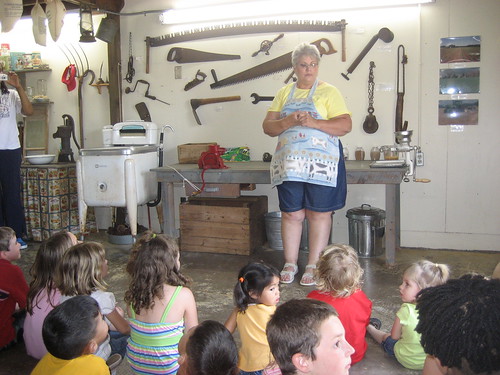
We went on a great field trip yesterday. The Virginia Beach Farmer's Market has a Heritage Center where they teach children about farming and home life before the advent of modern creature comforts.

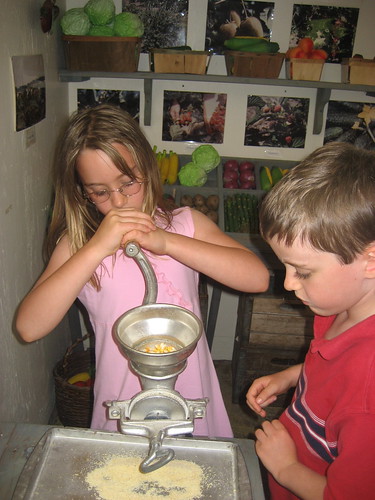
The kids were fascinated by all the non-electric tools.

The teacher did a great job of making the history accessible to the children.

I was a little disappointed though when she missed a golden opportunity to give a demonstration on gears and gear ratios when she demonstrated the butter churn.

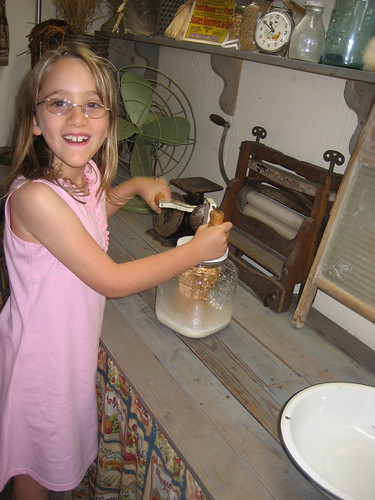
Here you can see Shira making butter.


Ben and Shira learned that grinding corn is a tough business when you don't have a Vitamix.


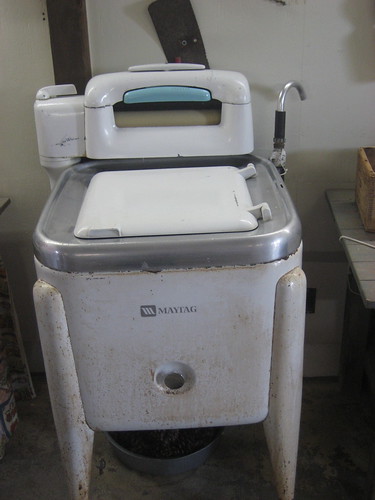
When I was growing up in South Africa it was a few decades behind the US. The backwardsness of the country was exacerbated by the fact that I grew up in a relatively poor, tiny town. Until close to the 1980's my family used a washing machine similar to this one.

I just loved using the mangle. I'll never forget the great excitement when one of my classmates bought an automatic washer and dryer in 1978. The entire school was agog over the machine that dried clothes. Now I can't imagine life without my automatic washer and dryer. How times change.

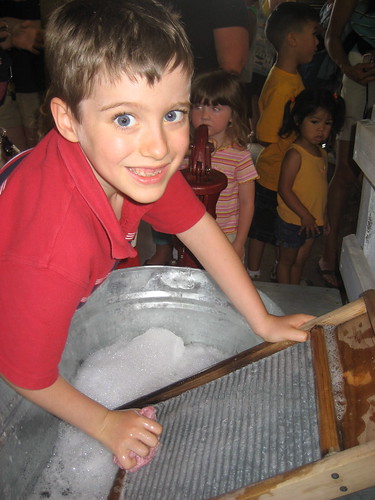
Ben had fun washing laundry on an old fashioned washboard.

I don't think it sunk in though just how much work washing laundry was in the days before washing machines.

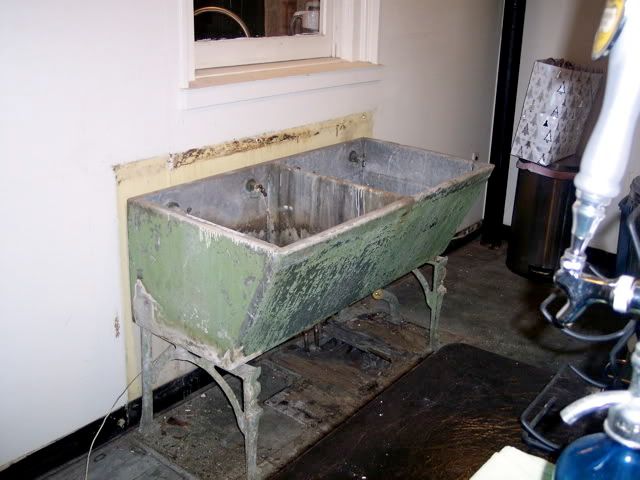
When I was growing up, our laundry had one of those old fashioned washing machines (ours was large and round) and two, large stone sinks with the corrugation of a washboard built into the angled front side. They were cleaned up versions of these ones.

About's Homeschooling Guide's Summer Reading Program

This is a summer reading program for K-12 homeschooled children.
The 10th Annual Summer Reading Club begins today, May 30, 2008! Get those library cards out!

Sign your children up for the 2008 Summer Reading Club provided by your About Homeschooling Guide.

In the past, I have done reading incentive programs for children that have been a big success and increased recreational reading. It helped to improve their attitude towards reading, made them more enthusiastic, and they read a lot more books. Besides that, children love to get mail.

The only cost for the summer program is a $1.00 stamp (this is the amount for a 2 oz. large envelope) to cover postage.

Sign your children up (K-12 Homeschooled)
Print out Reading List Form
Children read books at their reading level
List books on form and total pages
When the total number of pages reach 500, mail the list along with a $1.00 stamp to the address provided on the Reading List Form (one per student).
Your child will receive a certificate, stickers and a prize in the mail by September 30, 2008.
Deadline: Postmarked by August 31, 2008.

Yet another teacher outrage!

Last week we heard about the teacher who had her students vote on whether to keep an autistic child in the class, this week we hear about a teacher who verbally abused yet another kindergartener.

You can read the article here.

Calling a 5 year old child, "ignorant, self-absorbed, pathetic and selfish" is not acceptable. She then asked the entire class if this child is someone they wanted to be with. The class replied, "Nooo", in unison to which she replied, "See, your friends don't want to be with you. I don't know what else to tell you. So you are not going to have friends because of your actions.".

I understand that this child had behavioral problems all year, but still, an adult, who is charged with the care and nurturing of our children, should have better self control. She should have taken action long before she lost it.

The parents say the teacher suggested a behavior plan but when they pushed her for one, she replied that she didn't have time.

I've seen children's behavior when they are en masse and I don't envy classroom teachers in the slightest, however, that just doesn't excuse this type of behavior.

Carnival of Homeschooling is up

Have a look at the latest edition of the Carnival of Homeschooling at Tami's blog.

Monday, June 2, 2008

Duck takes up residence on woman's porch recliner

Now for something that has nothing to do with education or homeschooling. It's just a fun video to show to the kids.

For years, wild ducks have called this Virginia Beach neighborhood home. One duck has taken the word 'home' to a new level as 12 eggs are incubating on Harriet Lindenburg's front porch recliner.

Video can be seen here.

We miss our neighborhood ducks. For years we had a duck family that hatched the newest editions at the Chrysler Museum of Art. We could watch the ducks by going out our front door. Then one year, someone complained to the city pound and the ducks were rounded up and moved to the Norfolk Botanical Garden and we've not seen the ducks since then.

Now we have to walk all of 5 min to the The Hagueto see ducks.

Sunday, June 1, 2008

Talking to our children

A while ago I read that the best way to talk to boys is when you have them in the van. That boys don't like to be face to face when they talk. (I wish I could remember where I read it). I find it difficult to hold meaningful conversations in the van with my kids as I struggle to hear them from behind me, so I filed the info away for reference and thought no more of it.

A little while ago, while I was giving Shira a massage I realized that we have our own version of "van talking". Most nights I give the kids an aromatherapy massage and while I giving it to them, they talk to me. I'm finding out little gems about how the children think and more importantly they talk about issues that worry them.

The massages started as a way to help Ben and Shira relax before bedtime, but now I think they may serve an even more important role. I can see them lasting for many years to come. I love how it allows them to open up to me in a safe way. I'm sure that talking about their feelings while being touched makes it a much safer experience for them.